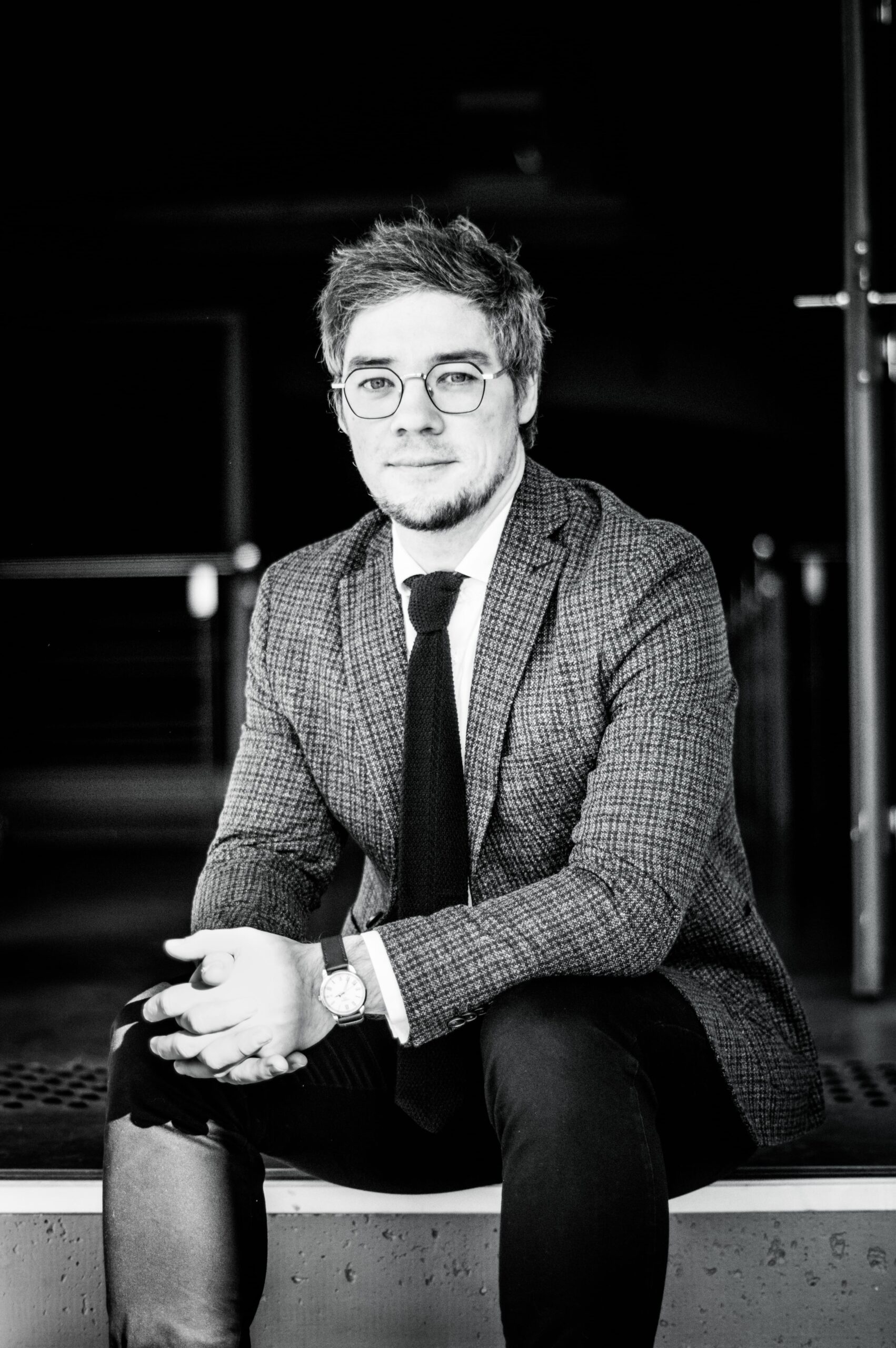
Prof. Teva Meyer is the Principal Investigator of GeoNuFE. He is an Associate Professor of Geography and Geopolitics at the Université de Haute-Alsace, affiliated with the Research Center on Economies, Societies, Arts, and Techniques (CRESAT-UR 3436) and a non-resident Fellow at the French Institute for International and Strategic Affairs (IRIS). After earning his PhD from the French Institute of Geopolitics (Université Paris 8) in 2017, he joined the École Normale Supérieure de Lyon as a postdoctoral researcher before being appointed at the Université de Haute-Alsace in 2019.
His research examines the political dimensions of the relationship between space and the nuclear industry, both civilian and military. Using critical geopolitics as an analytical framework, he conducts research across French Polynesia, Europe, and North America. His work explores the political dynamics of post-nuclear territorial redevelopment, nuclear-armed states’ fuel supply strategies, and the power struggles shaping the global nuclear industry. His research led to the publication of a popular science book, Géopolitique du Nucléaire : pouvoir et puissance d’une industrie duale, published by Cavalier Bleu in 2023 and of multiple paper available on his ORCID page.
After securing a Young Researcher Grant from the French National Research Agency (ANR) in 2020 (NucTerritory) to model the spatial relationships of nuclear power plants, he was awarded an ERC Starting Grant in 2025 for the GeoNuFE program.
• 09/2019 – Senior Lecturer, Faculty of Economic, Social and Legal Sciences, University of Haute-Alsace. Affiliated with the Centre for Research on Economies, Societies, Arts and Techniques (CRESAT UR 3436)
• 01/2019 – 07/2019 : Assistant Professor (contractual) in Geopolitics – Grenoble School of Management
• 01/2019 – 07/2019 : Editor – ‘Carto’ magazine
• 01/2018-01/2019 : Postdoctoral researcher at the École Normale Supérieure de Lyon – EVS – UMR 5600, ANR/Investissements d’avenir METROPOLITIN project (Political metrology of industrial waste in Europe)
• 09/2017 – 12/2017 : Assistant professor (contractual) in geopolitics – Grenoble Ecole de Management
• 09/2015-09/2017 : Assistant Professor in Geography in the History and Heritage Department at the University of Haute-Alsace
• 09/2012 – 09/2017 : Contractual doctoral student with teaching duties at the French Institute of Geopolitics (University of Paris 8)
• 2017 : Doctoral thesis in geography, specialising in geopolitics
o Centre for Geopolitical Research and Analysis (CRAG – EA 353) at Paris 8 University: » A comparative analysis of the geopolitics of civil nuclear power in Germany, France and Sweden » supervised by Philippe Subra
• 2012 : Master’s degree in Geopolitics – French Institute of Geopolitics – Paris 8 University
o Thesis: ‘A geopolitical analysis of the revival of nuclear energy in Sweden’ supervised by Philippe Subra
• 2011 : Master’s 1 in Geopolitics – French Institute of Geopolitics – Paris 8 University
o Thesis: ‘The Fessenheim nuclear power plant after Fukushima: local geopolitical issues’ supervised by Philippe Subra
• Critical Geopolitics of Nuclear Fuel Geopolitics in Europe (GeoNuFE) – 2025-2030
o ERC Starting Grant
o €1,346,830
• Geopolitics of Uranium Corridors (GeoCorUran) – 2024-2025
o Research Commission – University of Haute-Alsace
o €5,000
• Objectifying Nuclear Territorialities (NucTerritory) – 2021-2024
o ANR Young Researcher
o €232,200
• Fessenheim, the scales of nuclear territories (NuclearScale) – 2019-2021
o NEEDS exploratory programme – IN2P3, CNRS
o €17,720
• 2013-2023 : Clémence Maillochon, “Networks of activists against French nuclear testing (1959–1996)”, supervised by Renaud Meltz. Defended on 28 September 2023, University of Haute-Alsace – CRESAT
• Since 2021 : Laurent Zimmermann, “Geopolitical and geohistorical approach to the role of the white stork in the dynamics of the landscapes of Alsace, from 1871 to the present day”, supervised by Brice Martin, University of Haute-Alsace – CRESAT
• Since 2019 : Gaël Bohnert, “Analysing agricultural adaptation trajectories in the face of climate change in the Upper Rhine region (France, Germany, Switzerland): a network and border-based approach”, supervised by Brice Martin, University of Haute-Alsace – CRESAT
• Belinda Ravaz, “The redevelopment trajectories of nuclear territories. A comparative approach”, supervised by Pierre-Henri Bombenger, defended on 28 November 2025, University of Haute-Alsace – CRESAT
• Hungo Sanchez, “The definition of flood risk prevention plans in Alsace: between challenges and power struggles”, supervised by Brice Martin, University of Haute-Alsace – CRESAT
• 2021-2024 : Sascha Perroux, “From shutdown to conversion. Coal-fired power plants in France and their energy and industrial transition trajectories”, Aix-Marseille University
• Since 2023 : Maxime Laugel, “Protecting nature and the environment in Alsace, from the end of the 1968 protests to the late 1990s” – University of Versailles Saint-Quentin
• Since 2022 : Manatea Taiarui, “The Pacific Experimentation Centre and French nuclear testing in international relations (1957-1998)”, University of French Polynesia
• Since 2019 : Valéry Bardois, “Anti-nuclear activist movements: smugglers and networks”, University of Haute-Alsace
• Since 2018 : Wahel Rashid, “The conflict surrounding the CIGEO project”, University of Paris 8
• Symposium “Ta’ata, tuna and concrete : thinking about nuclear testing through circulation” University of French Polynesia, Papeete, 8–10 October 2025
• Study days : “Archives & Nuclear Power”, 25 and 26 November 2025, ASNR, Paris
• Study days : “Archives & Nuclear Power”, 20 and 21 November 2024, IRSN, Paris
• Study days : “Archives & Nuclear Power”, 6 July 2023, IRSN, Paris
• Symposium “Des essais au désert. Pour une histoire comparée et transnationale des sites d’essais nucléaires” (Desert testing: towards a comparative and transnational history of nuclear test sites), Inalco, Paris, 19–21 January 2022
• Symposium “Histoire et mémoire du CEP : un deuxième contact ?” (History and memory of the CEP: a second contact?), University of French Polynesia, 11–13 May 2022
• Symposium “Borders and the environment: Time, space, methods”, University of Haute-Alsace, 1–3 December 2022
© 2025 ERC GeoNuFE